
Reign of Queen Victoria:
CAPTAIN ALFRED LILLEY ((our ancestor) served in the Mercantile Marine (Merchant Navy) from 1862-1876.
- Retired from the Merchant Navy with a Master's certificate. 1877-1880 Served in the Eastern Cape Border wars - between the British and the Xhosa.
- 1899-1901 Served through the Anglo-Boer War.
- During reign of King Edward VII: 1901-1902 Served in the Anglo-Boer War.
ALFRED LILLEY married SARAH EATON (See earlier history of Alfred Lilley & Sarah Eaton here.) 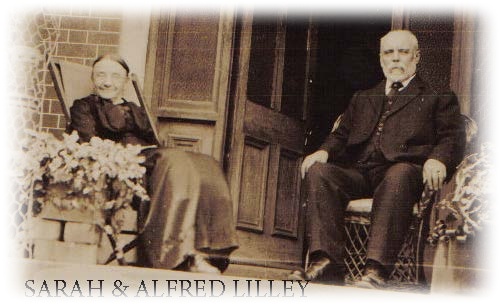
They had twelve children. Four survived infancy. (see history of Sarah Eaton)
1. LAURENCE EDMUND LILLEY (son of Alfred Lilley & Grandpa's brother) - Naval service record:
- During Reign of King Edward VII:1905-1908 Served in Naval Cadets.
- 1908-1910 Served in R.N.V.R. (Royal Naval Volunteer Regiment) (South African Division).
- 1910-1911 Served in Queenstown rifle volunteers (Queenstown, South Africa).
Reign of King George V:
- 1912-1913 R.N.V.R. (SA Division)
- 1913-1914 Served in the Union Defence force - granted a commission as Sub-lieutenant aval Cadets.
- 1914-1919 Served 5 years at sea with R.N.V.R. in the Royal Navy. Specialised in Signals having passed out of the Devonport Naval Signal School in 1916.
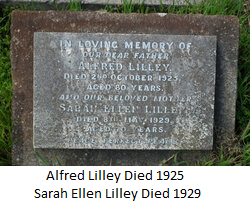
- Granted the Colonial Auxiliary Long Service and Good Conduct Medal, 1914/15 Star, General Service and Victory Medals.
Further details of service in World War I (1914-1918):
- 1914 Joined "HMS Hyacinth" for duties on Torpedo Boat 060.
- Later at Admiralty House Signal Station (Simonstown, South Africa)
- 1914-1915 Joined "HMS Kinfaus Castle (Armed Merchant Cruiser) for duties in East and West Africa, also India.
- 1915-1918 Sailed (9th October 1915) with 1st SA Naval Overseas Contingent.
- Drafted to Royal Naval Division (Hood Battalion) land service.
- Later drafted to the Mediterranean Fleet and served in following ships:
- "HMS Europa” Mediterranean Sea
- "HMS Ark Royal” Mediterranean Sea
- "HMS Aquarius" Mediterranean and Adriatic Seas.
- 1918 Drafted back to England and thence to South Africa, at end of the war.
- 1919 Demobilised in South Africa.
2. JOHN HERBERT LILLEY (son of Laurence Edmund Lilley above) - His Naval record:
28th March 1935, at age 13+ joined the South African training ship "General Botha", passed top in exams for 1st year Cadets. Went for his first sea voyage on "SS Otavi" to Durban and Walvis Bay, SWA. After returning to "General Botha" for further training, he joined the "Otavi" as an apprentice.
- 1939 Outbreak of World War II joined RNVR SA.
- Served on a Minesweeper "Kia", as a wireless operator, in the Mediterranean Sea.
- Later passed the exam for sub-lieutenant.
3. ALBERT EVITT LILLEY, son of Alfred Lilley and Sarah, nee Eaton, our ancestor and my grandfather. (1887 - 1966). He was born 10th February, 1887, probably at Seymour in the Eastern Cape as he was baptized in the Methodist church, Seymour on 10th May, 1887 by Rev Thomas Spargo.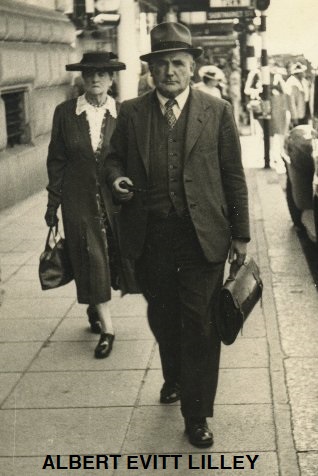
All I know of his younger days is that he attended Kingswood College (private Methodist school) in Grahamstown for some time - probably as a boarder. I have his school report for December 1902 when he was in Form III, aged 15. The subjects were Scripture (Book of Exodus); English (grammar, literature, dictation, composition); History (Tudor period); Geography (British Empire); Latin; Dutch (including something to do with German); Mathematics; Reading; Writing: Freehand drawing. There were 21 in the class and he came 13th. His conduct was very good.
He married Florence Bolton on 17th July 1909. They were both 22 years old. At the time he was working as a Gent’s Outfitter in King Williamstown, Eastern Cape. They eventually produced ten children. Albert Evitt worked for the South African Railways as a station foreman at Kenilworth station. The family lived first in Collingwood Road, Observatory and then in Timour Cottage on the grounds of Timour Hall Manor, Plumstead. (My daughter, Jeanette had her wedding reception at Timour Hall Manor). While at Timour Cottage, the eldest son, Evitt, died of Diphtheria, aged six years. He was buried in Plumstead cemetery. (I have some of the sympathy letters and cards that Grandma always kept in an old, green Victorian teapot of her mother's - on top of the display cabinet in the lounge at 79, Gibson road, Wynberg - now Kenilworth.) It worried my mother that there was no memorial stone on Evitt´s grave- the brother she never knew. In her old age she paid to have a wall put around the grave with the inscription - ¨Our dear brother Evitt Lennox Lilley Born 30-11-1909 - Died 8-1-1916”. Then she was content. That is not the end of the story. When my mother died, her body was cremated. My sisters and I decided to put her ashes in Evitt´s grave at Plumstead cemetery. So Neville and I went to check the grave. There was grass growing on the top, so we decided it would be possible to dig a hole for the ashes. On a Sunday we four daughters with a couple of husbands met at the cemetery to bury the ashes. Only to find that cement covered the grave and grass was growing in a superficial covering of sand. In the end, Mom´s ashes were scattered in the Garden of Remembrance, Bergvliet Methodist where the funeral service had been held.
My grandmother was pregnant with my mother at the time of Evitt´s death. Grandma would still shed a tear when speaking of her first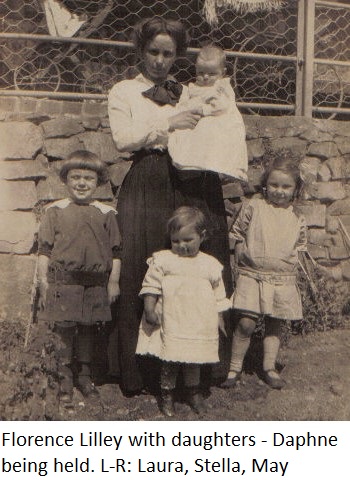 born in her old age. My mother, Daphne Florence Lilley was born on the Timour Hall estate. Grandpa was moved to Tulbagh Road station, a railway station on the main railway line between Cape Town and Johannesburg. He later left the railways to set up a business on his own. He started a barber shop in Tulbagh. Their son, Lennox Albert Lilley, was born at Tulbagh Road. Isabelle was born in Tulbagh. After the business failed, I think they returned to Cape Town and I believe they may have stayed for a while with our great grandparents, the Boltons in Sea Point.
Thereafter, they moved to Golden Sunset Farm at Klipfontein on the Cape Flats not far from a cement factory. (Probably now the area of Crossroads or Guguletu.) They were there from at least 1924 to 1930 - deduced from their monthly funeral fund contributions book which I have. They may have been there from about 1920 (as it was the second funeral insurance book) and almost certainly later than 1930 but cannot be sure of exact dates. The family built the house with their own hands and my grandmother is said to have lost her engagement ring in the walls of the house. There was no electricity and water came from a well. They had a wood stove. Washing was done by hand and many things were starched and ironed with the heavy, black iron heated on the stove. I think Uncle Kenny must have been born here, but certainly Uncle Stanley and Aunty Olive, the two youngest, were born while living on this farm. Grandma Florence Lilley told me that she had one pain, climbed on the bed and her youngest and tenth child (Aunty Olive) was born!
The children went to the New Eisleben school and had German friends and acquaintances. Their sandwiches had golden syrup on them and were wrapped in newspaper. They went to school barefoot and during winter broke the ice in the puddles on the way to school with their toes. My mother graduated with " boere matriek" (Std 6 or now grade 8). It was a reasonable standard of education in those days. She was always amazing at mental arithmetic - must have learnt it at that little farm school. Here are some stories from the farm, told to me by my mother.
Once, one of the boys, either Kenny or Lennox (unable to verify exactly which one) annoyed his siblings. In their mother's absence, the others held him down, placed a small bowl on his head and shaved off his hair around the bowl. The result was not good and he attended the Christmas party with a bonnet on his head. This Christmas party was held by a well-off German family for the poorer children in the district.
- Another time their Grandmother Lilley brought oranges for their father. My mother collected the peels, throwing them onto the path outside the house. Her thinking was that if they had visitors, the visitors would see the peels and know that the Lilleys could afford oranges! When her mother (my grandmother) discovered the peels, she made my mother pick them up. My mother ate the peels secretly.
- When the girls were older the boys of the area would come to visit. One boy was there on a night when it was pouring with rain. Feeling sorry for him, my grandparents offered to have him sleep over on the couch rather than cycle home in the rain. Then he disappeared. Gone to the toilet presumably, (obviously outside and not a flushing one!). Sometime later the boy reappeared at the house - soaking wet. He had ridden to his home to fetch his pyjamas!!
- Grandpa had a donkey and he made a rule that no boy could date one of his girls unless they could first ride the donkey. It was obviously an ill-tempered creature and threw every boy who got on its back. One managed to stay on - by riding it facing backwards.
How did Grandpa make a living on that farm? Don't know the full answer to that but the soil was poor and not great for crops. Grandpa did have a lime kiln and my mother was sent by bike to places like Mowbray to hawk, door to door, packets of pink powder that people threw into their toilet buckets for hygienic purposes.
My grandparents' marriage was not a very happy one, and so Grandma moved with the children to a semi-detached double-storey house in Wittebome and they attended Plumstead Methodist church. Aunty Corrie, an old family friend of Dutch background, stayed with them in Wittebome for a while and told me that everyone in the house on a Sunday was expected to go to the Plumstead Methodist church with the family. She said that the Lilleys always loved food and showed an interest in what they were going to eat! Later the family moved to No 4 Gibson road, (now 79, as the numbers were later changed), Wynberg. (The area is now called Kenilworth). This move was made in about 1936/37, because my parents got married from that house in 1937. Grandpa joined the family again, but he and Grandma always had separate bedrooms. They rented this house from the landlord, Mr Dunn, for about 30 years. At the end of every month, they made their way to lower Maynard Road, Wynberg to pay the rent.The house was one of four double story, semi-detached houses. It had a lounge with a tile fireplace, five bedrooms, a kitchen where we ate and the electric stove stood in an alcove where the wood stove had previously been, a pantry under the stairs (great for hiding in), a bathroom with a wood burning geyser and outside in the backyard a flush toilet and Maggie's room.
Maggie Apollos from Mamre, was the live-in domestic worker for many, many years. (Before Maggie there was Lena who retired to the Cape Flats where my mother visited her.) Maggie cooked and cleaned and in her spare time gave attention to her own chain stitch embroidery. She went home to Mamre on her annual holiday, presumably bearing gifts of embroidered items. She was part of the Lilley family until the house was given up after Grandpa's death. She then returned to Mamre. We always had roast beef or mutton on Sundays and chicken only at Christmas time. The left-over roast was used for sandwiches (with beetroot) on Sunday evenings and was curried for Monday's supper. We ate in the kitchen, the children sitting on a bench and the adults on old Bentwood chairs. Grandma loved the fat on the meat and finished off her meal with a slice of bread, butter and jam.
Sundays were special with our best clothes for church or Sunday School, English china in white, green, and gold and of course the roast and pudding.
Grandma did not go out shopping, The greengrocer came round with his horse and cart and presented a basket of fruit and vegetables at the front door for her to choose from. She phoned the grocer - Mr Gantovnik, an East European Jew, whose shop was down the end of the Wynberg Main Road - with her order. He sent the delivery man on his bicycle with a large wicker basket to deliver the goods. One day my cousin, Elva, was also delivered as he found her on the road and brought her home. The fish cart with horn blowing came by, probably on Fridays, as everyone ate fish on Fridays - Roman Catholics (that was their tradition) and Protestants - (just because!). The milkman left the bottles of milk at the gate each day. I think there was a confectioner with a van too. When my grandmother needed bacon, I was sent to Rafel´s, the local grocer to get the bacon freshly sliced. If we needed meat, we bought it from the butcher down Wetton Road and there was sawdust, or wood shavings, on the floor of the shop. If my grandmother needed new shoes, Mr Gelfin - another East European Jewish man - came to the house and fitted her shoes. He had a shop on the Main Road, Wynberg. If we needed shoes repaired, there was a shoemaker round the corner down Wetton Road. The refuse cart came round drawn by Clydesdale horses with huge feet. Their stable was in Rosmead Avenue. We were sent out with a dustpan to scoop up the droppings for the garden. The garden had some roses and a low wooden fence, also a bird bath later on - if I remember correctly. There were pots of plants on a tiered stand and a few chairs on the stoep. I spent quite a bit of time in the loquat tree in the backyard imagining I was a princess in her tower, I suppose.
Nearby Miss Hawthorn and other members of her family had a smallholding. There we bought fresh milk, and flowers for the teachers’ birthdays. She wore long dresses, boots and a felt hat. The hens wandered in and out of the house, where we went to pay.
Other local amenities were the tennis court at the Country Club in Wetton Road and the bowling greens up the road, on each side of Wetton Road, where Grandpa played. Wetton Road had no bridge but a set of booms and a pedestrian subway. Nearby was the railway goods yard where shunting took place (and we took shortcuts to get to Church St.) When the circus was in town, the Circus train was parked there. Of all the clowns, Tickey was our favourite. Outside the nearby Wynberg station there were hansom cabs with the horses patiently waiting on the cobble stones, opposite the Wynberg Town Hall, to take you home in style after you alighted from the train. Sadly, we always had to walk. At the bottom of Church Street were the three Patel shops. They sold fruit, vegetables, and sweets. One was known as the Girls’ shop (mainly women serving) and Aunty Olive enjoyed going there. From 1939 (after the war started) until 1952 we mostly lived with Grandma at 4, (79) Gibson road. Our family doctor was Dr Bekker (or Becker) who lived on the corner of Wetton and Main Roads, Wynberg where the Maynard Mall is now. His surgery was next to the house, but he also came to Grandma's house when someone was ill. He was a golfer and practised his putting on the lawn. At Victoria Hospital, Wynberg, he removed my tonsils, did my mother's D&C, set Uncle Kenny's leg, I think, and was probably the obstetrician for Margaret's birth. The GP of those days was a jack of all trades! During my training, I nursed him at Victoria hospital after he had a heart attack.
Further history of Albert Evitt Lilley.
Grandpa enjoyed rugby and took my mother with him to watch, probably at Newlands. I remember he had a framed photo of a rugby team of which he was a member but don't know where or when. My mother enjoyed rugby to the end of her days.
Grandpa was a very handsome and friendly man. During the war years he was made a petrol coupon controller. The owner of a garage in Wynberg reported him for being too generous with coupons for his friends. This was a serious offence in war time conditions and Grandpa spent at least six months in Pretoria central prison. It was a terrible blow for the family, especially Grandma. He returned home very thin and for years Grandma was too ashamed to go to church. Later, through Rev Jack Cook, Grandpa became a committed Christian and got involved in the men's groups at Wynberg Methodist church. He and Grandma attended Wynberg Methodist together. Those of us who sat in their pew were usually offered one of Grandpa's XXX strong mints.
Grandpa started a business laying parquet floors. He had a terrible old, dark green van that only deteriorated with the years. On it was the caption "We lay floors". Some of us irreverent grandchildren dubbed it "We lay eggs". The van lacked some glass and was practically held together with wire. But Grandpa kept it going for many years. He was very friendly with the local traffic cops, always offering them sweets. Would that count as a bribe, encouraging them to look the other way regarding that probably unroadworthy van?
Later he started a new business and the caption on the van changed to ¨We sand floors¨.
During this time, he burnt his hand badly with boiling hot tar. Grandma told me she was impressed with his courage. It must have been very painful.
Grandpa had a heart attack and was treated at Groote Schuur hospital. He reported to them that he had bleeding from the bowel, but it seems they did not investigate - probably thinking that it was due to the blood thinning tablets (possibly Dindevan). When they did take notice, it was too late. He had bowel cancer which attacked his spine and caused paralysis from the waist down. He died in Groote Schuur hospital on 9th February 1966, one day before his seventy-ninth birthday. He had even ordered cakes for the staff for the next day and been in good spirits, in spite of his condition, when he took the turn for the worse that ended in his death. The whole family was with him the evening before, my mother being the last to arrive. His last words were, "Where is Daphne?' When they told him she had come, his last conscious act was to nod his head. The family stayed until 9:30 p.m. Louis Van Boom, son-in-law, organized a private nurse who stayed with him until he died at 1:45 am the next morning, still in a coma. His remains are buried at Plumstead cemetery. Many attended his funeral and there were 55 wreaths and sheafs (and a posy from Maggie to her "Oubaas") which showed in those days that he was appreciated by his family and community. The family also took comfort from the many tributes that appeared in the newspaper. He left behind his wife, eight children - all married - and twenty-one grandchildren. At a rough guess there are now about fifty great-grandchildren as well and the great-great grandchildren are increasing too.
A word about World War II - the A. E. Lilley family had 5 children in uniform plus 6 spouses. The Gibson Road home was open to British servicemen passing through the Cape en route to the East or returning. Their hospitality looked suspicious to some neighbour who reported them to the authorities for having "soldiers, sailors, and all sorts"!
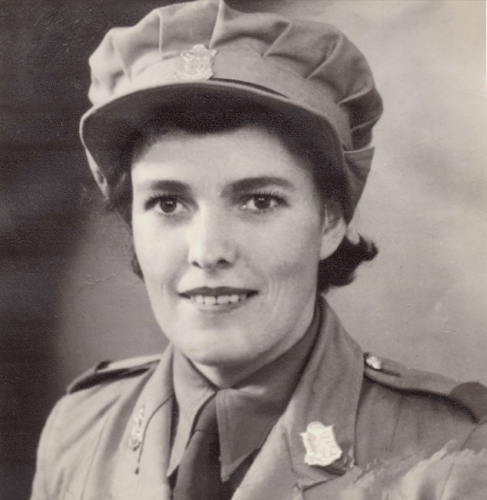
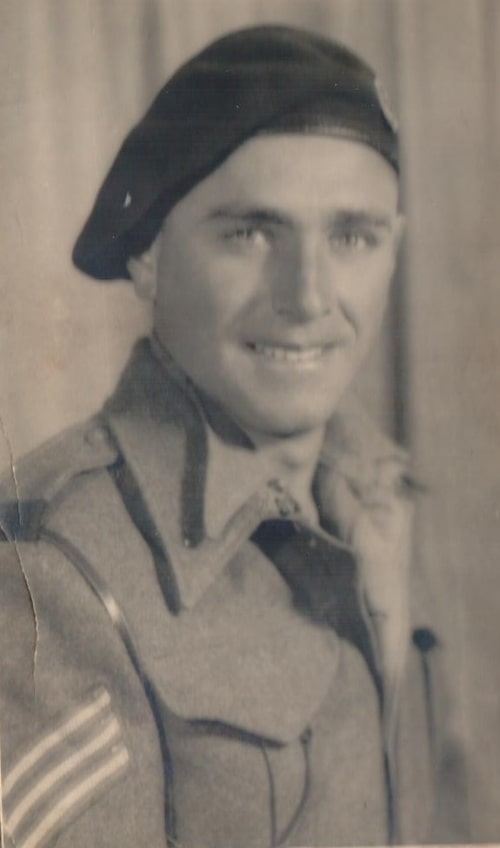
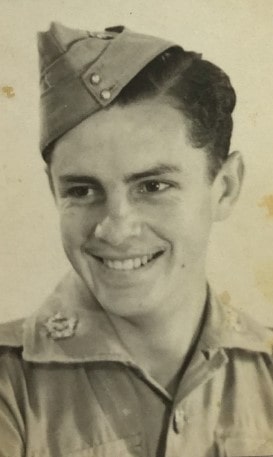
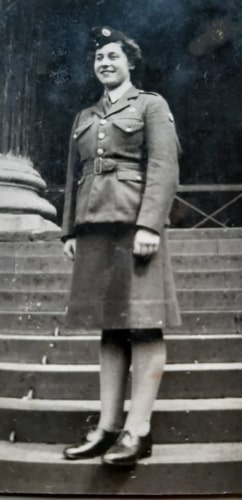
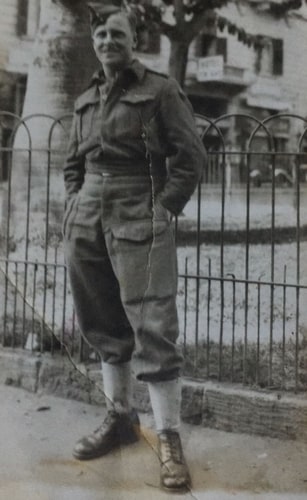
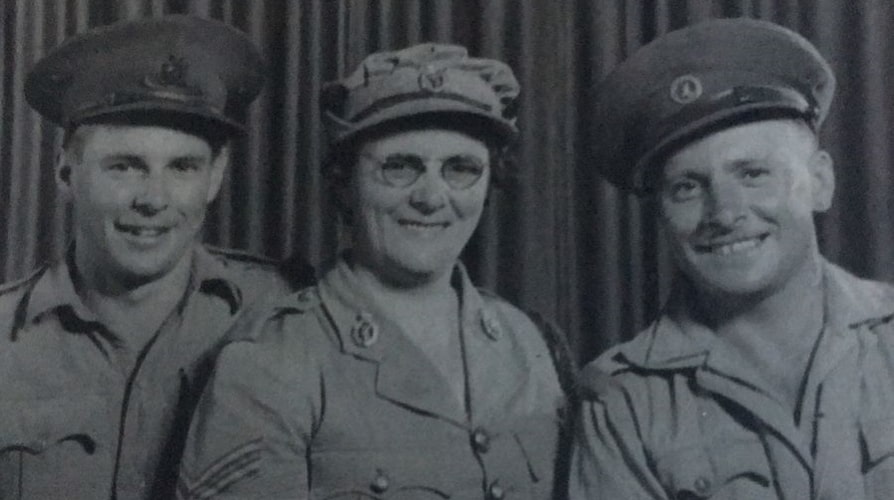
L-R: Daphne, Lennox, Stanley, Doris, George Keenan, Kenneth Lilley with Leah Keenan (George's mother) and George Keenan.
FLORENCE LILLEY (NÉE BOLTON ) (1886 - 1974) - Spouse of Alfred Evitt Lilley.
FLORENCE BOLTON was dedicated as a baby in Cape Town Baptist church in the presence of the same pastor as had officiated at her parents’ marriage in Grahamstown - Rev. L. Nuttall.
I do not know much about her schooling. However, I know she studied High Dutch at school, as a second language presumably, but did not speak Afrikaans. Florence trained to be a milliner. I think she probably met Albert Evitt Lilley through the Observatory Methodist church. He was originally interested in one of her sisters, I heard - probably Laura who was quite pretty. Grandma had a sweet but plain face.
FLORENCE BOLTON married ALBERT EVITT LILLEY on 17th July 1909. They were married by licence in a private home in East London, Eastern Cape by the Wesleyan Methodist minister, Rev Walter Bromiley. My great grandfather, Benjamin Bolton and the minister's wife were the witnesses.
Florence and ¨Bert¨ had ten children, four boys and six girls. Evitt died aged six and Stella died in her thirties. The rest of the family lived to be older. Only the second youngest, Stanley, now 94, and living in Swanage, UK., is still alive in 2021.
Florence Lilley had a hard life but was much loved by her children and grandchildren - and other friends. She was the kingpin around whom the family revolved. As a child I lived in their home in Gibson Road. She helped to bring me up as my mother was working. Grandma gave me some spankings, like the time I kept the change after going to the shop for her. She was a stable anchor in my life when my parents got divorced and a stepfather came into my life, and I had to go away for holidays to my father's parents where I got very homesick. When I had an earache or was ill with whooping cough, my comfort was to lie in Grandma's bed. She took me with her on the "holiday train" over the Christmas holidays to visit Aunty Isabelle in Grahamstown when I was in Std 2 (Grade 4). Coral was a baby and was christened at that time - 2nd January 1949. She also took me to East London with Aunty May when I was in Std 7 (now Grade 9). We stayed at the Windsor Hotel and the names were put in the newspaper. At last we had made it on the social scene!
During high school, although we now lived in Lansdowne, I would still cycle home from Wynberg Girls' to Grandma's house for lunch. During my nursing years I visited Grandma and we had long conversations. She told me that I was the first person with whom she had ever discussed sex! Grandpa would give me a lift back to the hospital in that awful old van - still going. The first time I brought Neville home was to Grandma's house, as our family were staying there temporarily before moving to the farm at La Motte. Grandma made my wedding dress as she had done so many others before. She travelled with my mother on the "holiday train" to Johannesburg for our wedding. After Grandpa died, 79 Gibson Road was given up - too large and Maggie too old to cope. Grandma moved to a flat off Gibson Road, Kenilworth. I think she was very lonely there. Over the years 79 Gibson Road always had an open door. Family and friends came and went at any time - and now she was kind of cut off. Later she moved to a flat in Aliwal road, Wynberg - opposite Wynberg Girls' school - with her sister, Laura. She became more and more forgetful, e.g. leaving the stove on. Probably suffering from early dementia, Aunty Isabelle arranged for her to go into a private home in Observatory where senior ladies were cared for. I was away but visited her there when we were in Cape Town. She had her own bedroom at the back of the house and we chatted in the lounge. There she stayed until her death on 19th April, 1974 - aged 87. Her remains are buried with Grandpa's and Aunty Stella's at Plumstead cemetery.
Grandma holds a special place in my heart. She was strict but full of fun, and always a lady. I remember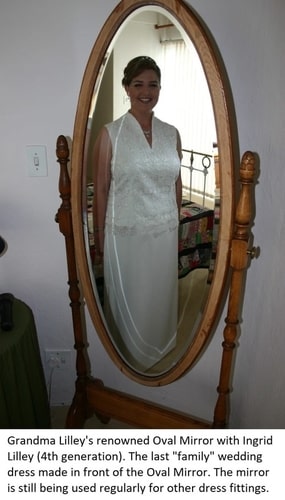 her children often teasing her as she got older, but it was a sign of their great affection for her. She took it all with good humour. She had very thin hair that she rolled up in silver coloured, flat, metal curlers. (She lost her hair during the 1918/1919 flu pandemic, when she was extremely ill.) Once set, her hair was kept in place by a hairnet, A hat, often remodelled by herself and decorated with artificial flowers was worn when she went out. She made her own dresses. She always wore corsets - tighter ones for going out. She loved the fat on the meat and used to finish her meal with a slice of bread and jam. She earned money over the years through dressmaking. Her bedroom was her workroom. There were lots of dress patterns, and buttons in a layered wooden box (lovely for little girls to play with), customers coming and going. She sewed many bridal dresses, including my own. She made some dresses for me and complained about my hollow back when fitting them. She had a treadle machine and later an electric motor was fitted to it. She also had an adjustable dummy on which dresses were fitted. She used to send us down Wetton Road to a lady who did covered buttons - to deliver the material and collect the, then fashionable, completed buttons. Scissors, pinking shears and paper for patterns, a tape measure, thimble, needles, and pins were part of her life, also a long oval mirror and a rubber tube and pump on an adjustable wooden stand - a chalk hem marker - to mark the length of the hem while the dress was on the customer. She did not sew on a Sunday. We were not allowed to knit on Sundays - it was work! Sunday you rested from work.
Grandma loved to go to the cinema to see cowboy films - this rather genteel lady!
She had clear ethics but was compassionate and caring. Boasting, pride and dishonesty were abhorred. Not much praise was given, lest we become swollen headed. Respect for authority was part of our upbringing. As she got older, Grandma was easily moved to tears. There was never any vulgar language in her home and never any liquor except maybe port, for the trifle pudding. Ladies did not smoke seemed to be an unwritten rule. She was a faithful member of the Women's Auxiliary at Wynberg Methodist church in later years. I was in Lebanon when she died, so could not be at her funeral. I should love to have tea with her and talk to her to-day.